The selloff is loud enough that even “I’ll just wait” starts to feel like a decision. Cash looks calm on the screen, but it isn’t neutral in your head—you’re watching prices move without you, and you’re also imagining the moment you buy and it drops another 8% the next week. In a taxable account, that hesitation has a cost too: the longer you sit, the more likely you end up chasing a bounce with a bigger, more emotional order.
Wanting “the bottom” is really wanting certainty, and the market rarely offers that on schedule. The problem is your cash wants a clean signal, while the tape delivers messy ones: one strong day, a scary headline, then a gap down. So the first move isn’t picking a date—it’s admitting what you’re actually trying to avoid (immediate regret) and what you’re willing to pay for it (missing part of the rebound).
The first dip looks tempting, then keeps dipping
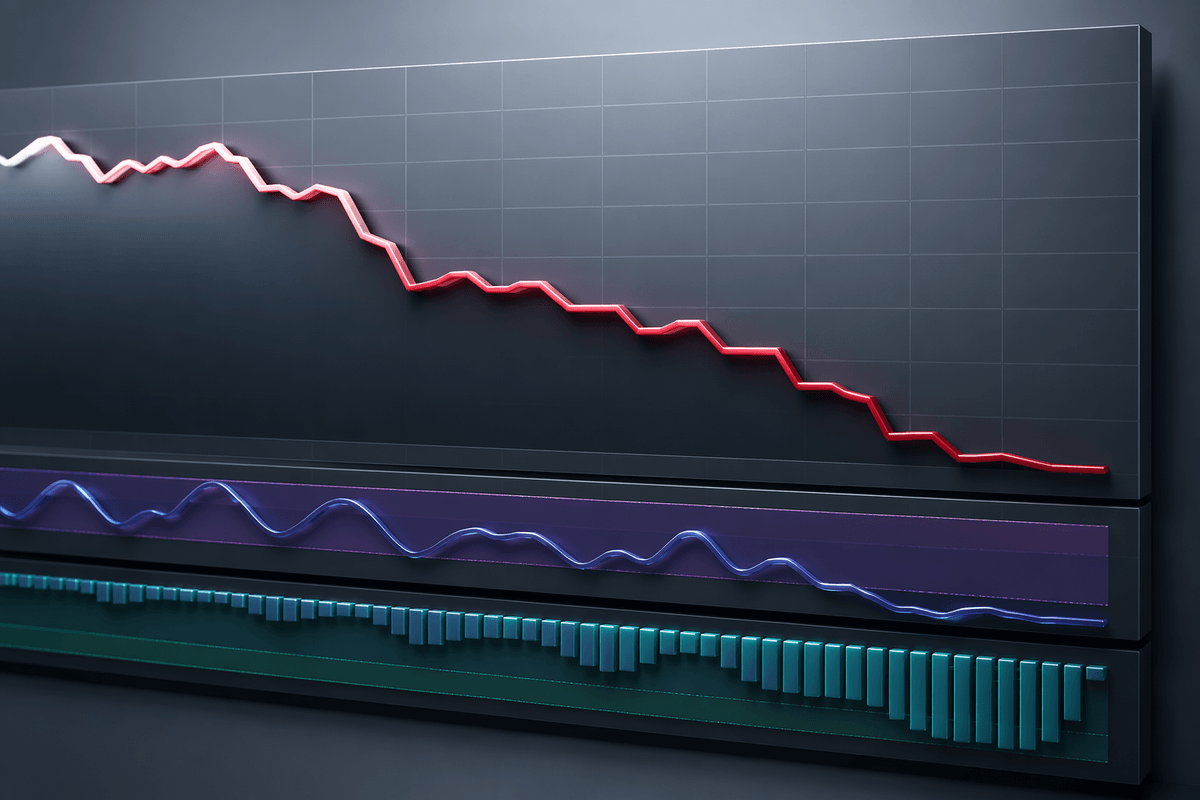
So when the index finally drops 3–5% in a day, it feels like permission. You’ve been waiting, the chart looks “oversold,” and the talking heads start floating the same line: “capitulation.” A small buy quiets the anxiety for an hour. Then futures turn red again, the open gaps down, and what looked like a dip becomes a staircase. The real friction is timing: your brain prices the first entry as a verdict on your skill, not a single step in a longer process.
The first dip is tempting because it’s the first moment that looks tradable, not because anything has changed underneath. Selling pressure often clusters—funds rebalance, margin gets called, earnings guides reset—so the market can keep repricing even after a “good” down day. If your plan was “buy when it’s down enough,” you’ll keep moving the goalposts: 5% becomes 8%, then 12%, and each revision makes the next click harder.
What matters here isn’t whether the dip was “the” dip; it’s whether your first entry was sized like it could be wrong. If it wasn’t, the second leg down stops being information and starts being stress.
Stop guessing: define what you can observe
After that second leg down, the urge is to label it: “that was capitulation,” “that’s a bear-market rally,” “this is the bottom.” The label feels like control, but it’s mostly a story stapled to a chart. In real time, you don’t get to know if a scary open was exhaustion selling or just a pause before another reset, and betting your cash on that distinction is where people size up too early.
Instead, shift to things you can actually observe without pretending they predict: the market’s recent low and whether price is holding above it for more than a day; whether down days are still making new lows; whether your target positions are making lower lows with the index or starting to stabilize; whether volatility is expanding or compressing. None of that “calls” the bottom, but it gives you a scoreboard you can check while scared.
Once you have a scoreboard, your entries stop being guesses. They become conditional steps: “I buy a first tranche only if the prior low holds for X sessions,” or “I add only if we’re above my last buy.” You’re not forecasting; you’re responding to what’s in front of you, with fewer heroic clicks.
Pick an entry plan you can follow scared
With that scoreboard in place, the next constraint is psychological, not analytical: you’re going to be placing orders while headlines are still ugly and your last buy might already be underwater. So the entry plan has to survive fear. The common failure mode is designing a “perfect” ladder that only works if you feel confident—then skipping step two because step one hurt. In a selloff, the plan isn’t the math; it’s whether you can repeat the behavior on a down open without renegotiating the rules.
A workable structure is a small “proof” tranche, then only add on improvement. For example: commit 20% of the cash allocation after the prior low holds for a set number of sessions, then add 20% each time price is above your most recent buy by a modest amount (or after a higher low forms), stopping if it breaks the prior low again. This costs you some upside if the rebound is vertical, but it buys something more valuable in a taxable account: fewer panic-sized fills at the worst moment.
The point is not to be early; it’s to stay in process. If the market keeps falling, you’ll be glad the first click was intentionally unimpressive.
Your downside limits: where you admit you’re wrong

That intentionally unimpressive first click only works if the next click has a boundary. Otherwise every add becomes “averaging down” dressed up as discipline, and the position quietly grows until it’s too big to manage. The practical question isn’t “how low can it go,” it’s “at what point does my original reason for stepping in stop being true?” If your scoreboard was “the prior low holds,” then a clean break and close below that low for a set number of sessions is an invalidation, not a vibe.
Downside limits can be price-based (exit the most recent tranche if it’s down 10–15%, stop adding if the index undercuts the low), size-based (no more than X% of the portfolio in this idea until a higher low forms), or time-based (if there’s no stabilization after four weeks, pause). The constraint is real: selling feels like paying for a mistake. But writing the “I’m wrong here” line in advance keeps one bad stretch from turning your whole cash plan into a rescue mission.
Reduce regret with rules for taxable accounts
By the time you’re adding tranches, the taxable account starts whispering its own threat: “If I sell, I made it real.” That’s how people turn a clean invalidation into a months-long hold, not because the thesis improved, but because realizing a short-term loss feels like a penalty plus paperwork. The constraint isn’t theoretical—wash-sale rules can block a clean reset if you sell and then try to rebuy quickly, and short-term gains turn “nice timing” into a higher tax bite if you flip a rebound too fast.
So the rules get more specific. Keep “invalidation sells” and “tax decisions” separate: if your scoreboard breaks, you cut the newest tranche only (the one with the smallest embedded loss), and you do it with a minimum wait rule before repurchasing the same name. When you add, prefer lots you’d be willing to hold longer, and track cost basis by lot so you can harvest losses without touching older shares. It won’t feel elegant in the moment, but it keeps one bad week from forcing a tax-shaped mistake.
A bottom isn’t a day—it’s a range
After a few tranches, the fantasy shifts from “nail the bottom” to “just don’t be the idiot who bought the top of the bounce.” That’s the tell that the bottom is already behaving like a process, not a timestamp. In real selloffs, price chops: a low, a weak rebound, an undercut, then a grind where bad news stops making new lows. The constraint is time—you can’t wait for certainty without paying for it in missed upside, but you also can’t buy all at once without paying for it in stress.
So treat “the bottom” as a range you work through with rules: you start when prior lows hold, you add only on higher lows or reclaiming key levels, and you stop if the range breaks cleanly. If it rebounds without you, you still get partial participation. If it revisits the lows, your sizing and invalidations were built for that mess.










![6 Best Money Market Funds [Protect Your Savings in 2026]](static/image/2026/07/14/fc8225e7-a6f6-459f-8150-f54bd9c52f6f.png)