Planning Kyoto is really choosing your pace
I froze over a Google Maps screenshot at 11:47 p.m., thumb hovering between “Save” and “Remove” on yet another temple pin. The route looked tidy on-screen—blue line, neat ETAs—but it also asked for three transfers before breakfast. My first Kyoto mistake was assuming the city rewards ambition the way Tokyo does.
Kyoto planning is less about collecting “must-sees” and more about picking a pace you can repeat for five straight days on tight PTO. A fast pace (two districts a day, early starts, lots of buses) works if you treat photos like quick proof—wide shots, a few details, move on. A slower pace (one district + one anchor sight) suits anyone trying to film, write, and still notice small things like incense drift or light on tatami; the trade-off is you’ll skip famous spots and feel that tug of FOMO.
Crowd flow makes the pace decision non-negotiable. The same lane through Fushimi Inari can feel like a quiet hike at 7:00 a.m. and a shoulder-to-shoulder conveyor by late morning, which changes what “good photos” even means. If you’re not a morning person, plan for fewer headline temples and more neighborhoods where wandering is the point—Demachiyanagi riverside, Nishiki’s edges, back streets in Gion—because forcing dawn schedules usually collapses by day three.
Pick dates that match your light
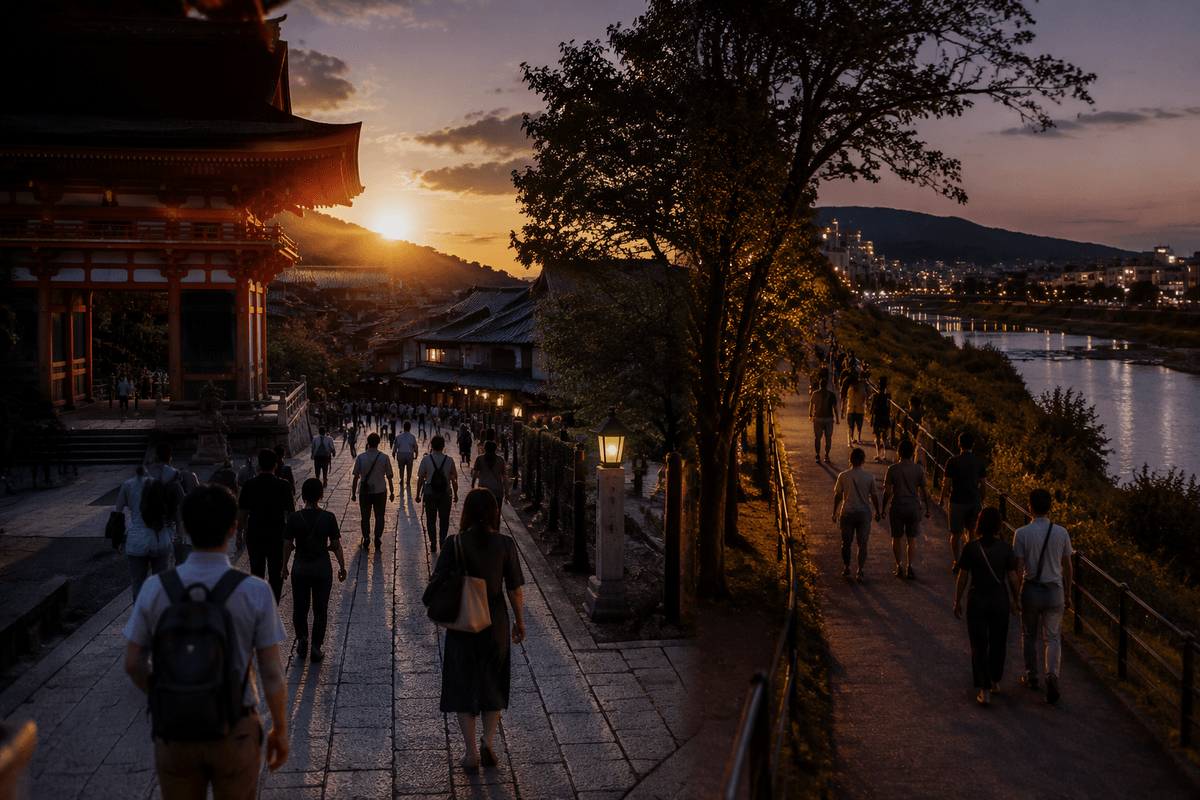
I realized I’d picked my Kyoto dates like they were just five empty squares on a PTO calendar when the weather app showed a week of flat gray—right over the only days I could travel. At 6:22 a.m., coffee cooling beside my laptop, I watched sunrise creep later while my “golden hour” plans stayed stubbornly the same. The map didn’t warn me that light, not lists, would decide what felt effortless versus rushed.
Kyoto “looks” different depending on season in a way that matters for both photos and fatigue. Late March/early April can deliver that bright, delicate spring look, but it’s also the period where crowds compress every walkway, and you’ll trade clean frames for patience. Mid-to-late November often gives richer contrast and more flattering street color, yet the same popularity means higher room rates and fewer flexible booking options. If you want calmer pacing, shoulder weeks (early spring before peak bloom, or early autumn before peak color) usually give softer light and more breathing room—just accept you might miss the postcard moment.
Day length is the sneaky constraint: many temples and gardens effectively “end” around late afternoon, so winter’s early sunset can turn your second district into a dim commute. Summer buys you more evening light for Gion alleys and river walks, but the humidity can flatten your energy by noon. If you hate early starts, prioritize west-side afternoons (Arashiyama, Saga) and save east-side mornings for another trip; if you can do one dawn, spend it where crowd flow punishes lateness.
Choose a base that saves hours
I noticed it at 8:03 a.m. on a Monday: the bus stop outside Kyoto Station already had a soft, impatient line, and my “easy” ride to Higashiyama had turned into a standing-room negotiation with daypacks. I’d booked the station area because it felt efficient—trains, shinkansen, luggage. In practice, the first hour of every morning was disappearing into transfers and crowd flow.
If your five days lean temple-heavy (Kiyomizu-dera, Gion alleys, Philosopher’s Path, Nanzen-ji), a base around Shijō–Kawaramachi or Karasuma Oike usually saves more time than Kyoto Station. You trade a slightly smaller room for better “walk first, transit second” mornings: you can step out early for quiet streets and come back for a reset before sunset. Kyoto Station works best if you’re doing multiple day trips (Nara, Osaka) or you’re arriving late and want zero friction—just accept that east-side mornings can feel like commuting.
Mid-budget reality: pick a hotel within a 6–8 minute walk of a subway station and a convenience store, then budget for tactical taxis when buses stall (especially after 4 p.m. when temples empty and everyone moves at once). It doesn’t suit travelers who want silence—central streets are lively—but if you want clean photos without dawn heroics, being able to slip out at 6:45 a.m. matters more than a perfect lobby view.
Build days around districts, not sights
At 7:18 a.m., I stood on Sanjō Bridge with a coffee and a battery at 62%, watching my route zigzag across town like it wanted to prove something. I had Kinkaku-ji, Nishiki Market, and Kiyomizu-dera “before lunch” because each pin felt close in isolation. The first bus that rolled in—already half full—made the flaw obvious: Kyoto isn’t hard, it’s just spread out.
Plan by districts and you’ll feel the city click into place. A workable rule is “one district + one anchor,” with transit that stacks in a single direction: Higashiyama/Gion (walk-heavy, early light, narrow lanes) as a morning block, then a late afternoon reset back near your base, then an evening stroll that doesn’t require another bus gamble. Trying to “just pop over” to Arashiyama between east-side temples looks efficient on a map, but it burns an hour in transfers and shows up as fatigue right when crowds peak.
It works best for first-timers who want strong photos without sprinting: pick a district, arrive early, and shoot wide-to-tight (streetscape → gate → details) so you’re not still framing the same corner at 10:30. You’ll skip a famous sight some days; that’s the point. If you only book one timed entry, book the place that collapses your flexibility (a popular garden or tea slot), and let everything else orbit around where your feet already are.
Document the trip without living on screens
I hesitated at the entrance to a dim temple hall with my phone halfway up, screen glowing brighter than the room. A small sign with a camera icon and a red slash sat at knee height, easy to miss if you’re already thinking “one quick shot.” I backed off, zipped the phone away, and realized how fast documentation can turn into friction—socially, not just logistically.
If you want photos and video that feel “Kyoto,” treat your camera time like a set, not a constant habit. I like a simple loop: 3 wides (street or garden geometry), 5 mediums (gates, lanterns, corridors), 10 details (paper charms, roof tiles, hands at a rinse basin). It works better than endless roaming because you stop hunting for a perfect frame once you’ve filled the list; the trade-off is you’ll miss spontaneous moments, but you’ll be present enough to notice them first.
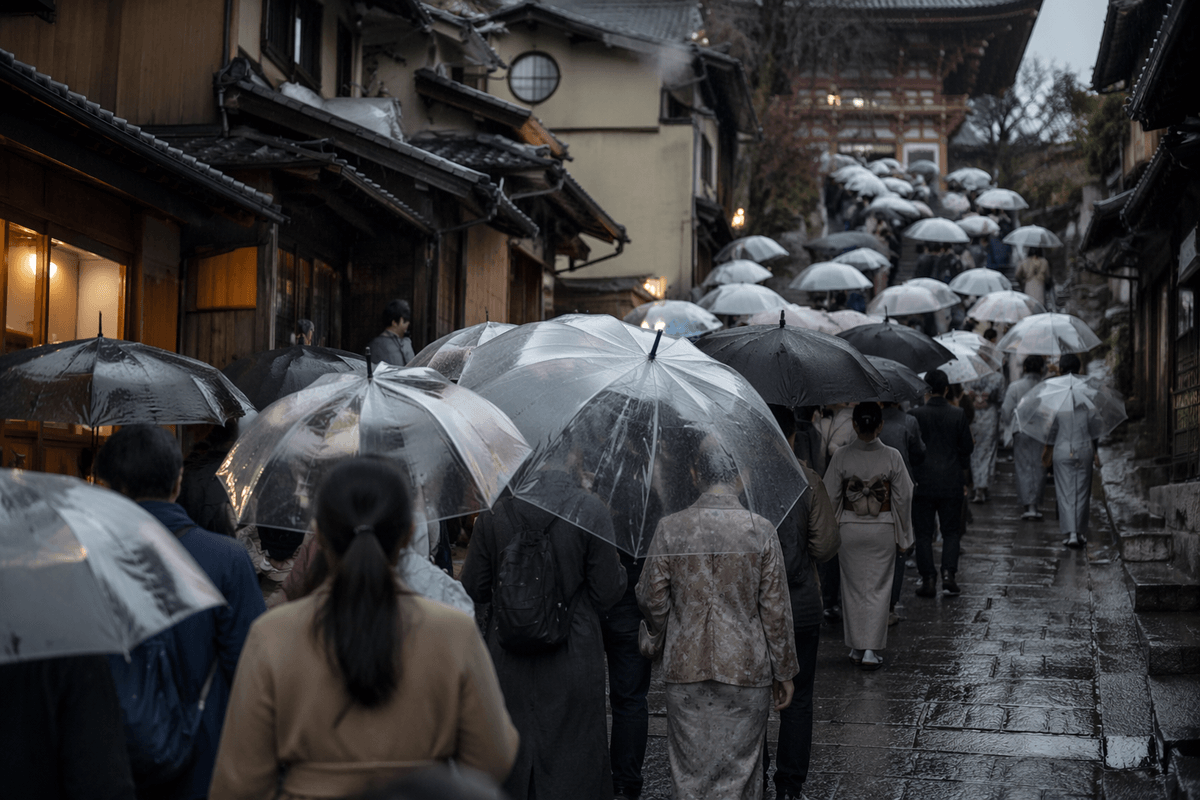
Etiquette is also a time-saver: assume no photos indoors unless it’s clearly allowed, don’t block narrow lanes for tripods, and keep voices low where people are praying. When crowds compress, I switch from “people-free postcard” to “flow story” (feet on stone, umbrellas, queue curves), which is both more honest and less exhausting. Each night, spend 12 minutes: one sentence per district, star 5 favorites, then back up to cloud plus a second copy (hotel Wi‑Fi permitting). It’s boring—until day four, when your memory starts dropping frames.
If it’s your first Kyoto trip
At 6:41 a.m. on day one, I paused at the ticket machine with a handful of coins and the wrong confidence, watching commuters slip through while I poked at the English menu. The platform signs made sense, but my itinerary didn’t: I’d planned three “iconic” stops before noon and hadn’t decided which ones needed an actual reservation. That tiny stall—standing still while everyone moved—was the first clue that Kyoto punishes vague plans more than it punishes slow travel.
If it’s your first trip, pick a base that forgives mistakes: Shijō–Kawaramachi or Karasuma Oike lets you walk into Higashiyama/Gion early and still retreat for a midday reset, while Kyoto Station is only “efficient” if you’re stacking day trips. Book just the pieces that remove flexibility (one timed garden/experience, one special dinner if you care), then leave the rest as district blocks you can slide earlier or later depending on crowds and weather. Buses are fine until they aren’t; the trade-off is cost versus certainty, so save taxis for late afternoon when your legs are cooked and the bus lanes feel like molasses.
For temples, assume a simple rule: outdoors is usually okay, interiors are often not, and signs win even when the shot is tempting. If you want a keepsake without turning every stop into content production, set a “two-minute capture” timer at each anchor sight, then put the phone away and write one line before you move on. It works for first-timers who want strong photos and a real memory; it doesn’t suit anyone chasing a perfect, empty-frame Kyoto at 11 a.m.—that’s a different trip.



![6 Best Money Market Funds [Protect Your Savings in 2026]](static/image/2026/07/14/fc8225e7-a6f6-459f-8150-f54bd9c52f6f.png)