Berlin’s real question: where walking actually works
On my second swipe of the map—standing on a U-Bahn platform with a damp jacket and 12% battery—I watched Museum Island and East Side Gallery sit on the same screen like they were neighbors. Then I zoomed out and the “easy walk” turned into a long gray stretch of city blocks, bridges, and crossings. Berlin can feel compact in a list, and sprawling in your legs.
The real question isn’t whether Berlin is walkable; it’s where walking stays efficient before it starts eating your weekend. Mitte is the obvious “I can walk to history” zone, but it’s also where a mid-budget room can jump in price fast—paying more to save steps. Prenzlauer Berg and parts of Friedrichshain are kinder on cafés and neighborhood wandering, yet they can turn a Reichstag morning into a timed event: either a 45-minute walk you’ll regret by day three, or a quick hop that makes transit the quiet hero.
If you’re here for four days, walking works best inside clusters: a morning of central sights, an afternoon of one kiez, then a reset back at your base before dinner. The trade-off is simple: choose one “home radius” where you can do breakfast and a late-night snack on foot, and use U-/S-Bahn to stitch the hubs together. If your feet are already skeptical—or the weather turns—plan for fewer marathon cross-city walks and more short, intentional ones.
What makes Berlin so walkable
Outside Hackescher Markt, I paused at a crosswalk with a red Ampelmännchen and a stream of bikes slicing past the curb like it was their private lane. The sidewalk was wide enough to breathe, but the rhythm wasn’t “stroll anywhere”—it was “walk, wait, cross, repeat,” and you feel it after a few kilometers. Berlin’s walkability starts with the basics: mostly flat terrain, long straight streets, and neighborhoods built to be lived in, not just photographed.
What makes it work, especially for a four-day weekend, is the way sights and food sit on top of each other once you commit to a micro-area. In Mitte you can stack history with low-friction walking—Brandenburg Gate to the Holocaust Memorial to the Reichstag area—without constantly re-routing. In Prenzlauer Berg or Friedrichshain, the payoff is different: cafés, parks, and dinner options appear every few blocks, so your “walking miles” feel like browsing instead of commuting. The limitation is the gap between hubs: Alexanderplatz-to-East Side Gallery looks close on a screen, but it can become a long, samey trek when it’s windy or your feet hit that day-three wall.
The sweet spot is treating walking as your default inside a kiez, then using U-/S-Bahn as a time-saver between clusters. If you’re the type who likes flexibility, you’ll walk more—and enjoy it more—by skipping the heroic cross-city marches that eat lunch reservations and museum slots.
Pick a base that saves steps
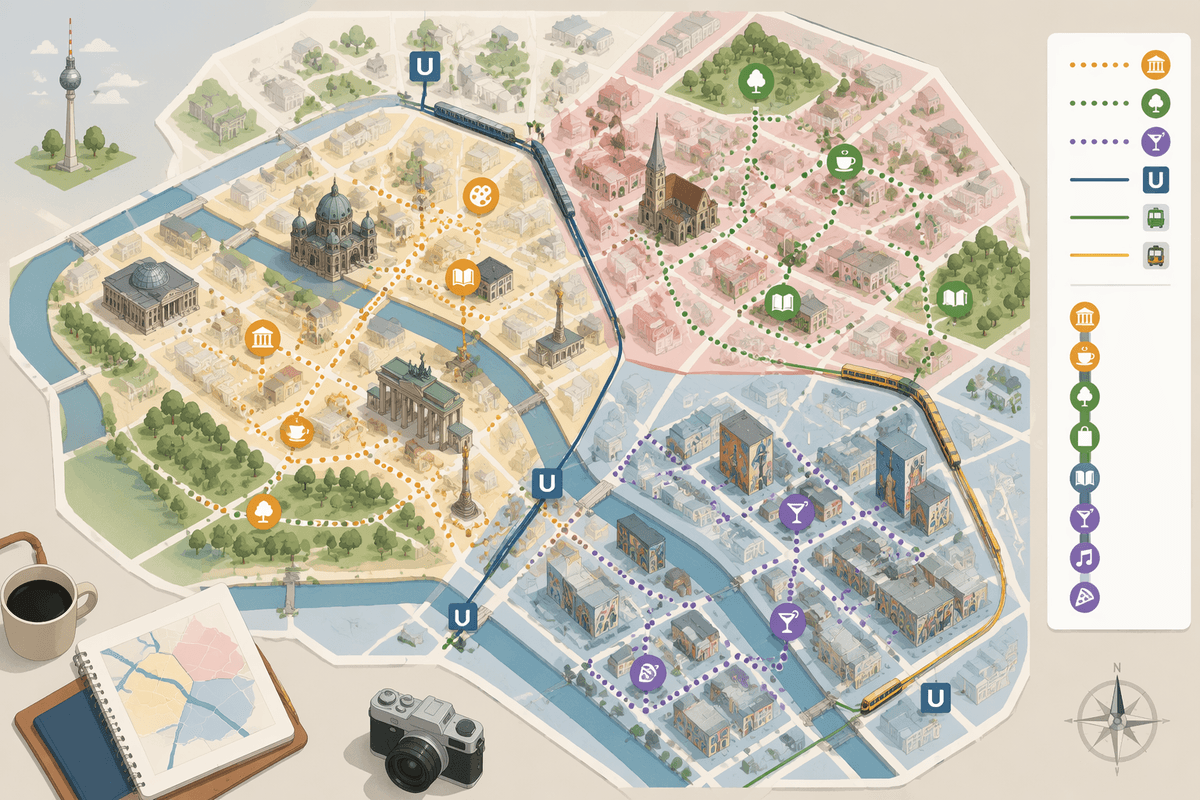
I hovered over a “Mitte” hotel pin at €165 a night and watched the last room vanish while I was comparing distances to the Reichstag. The cheaper option in Friedrichshain looked fine until I checked the walking time to Museum Island: 55 minutes, mostly along roads that don’t feel like a scenic stroll. That’s when “walkable” stopped being a vibe and started being arithmetic.
If your four days are history-forward, a base in central Mitte (around Friedrichstraße, Hackescher Markt, or just west of Alexanderplatz) is the boring-but-effective choice: you can walk to the big-ticket core early, before tour groups thicken the sidewalks, and still have U-/S-Bahn lines to escape without turning dinner into a timed commute. The trade-off is price and a slightly less “neighborhood” feel at night; it works best if you’d rather spend on location than on extra taxi rides or sore-feet recovery.
If you want cafés, parks, and wandering that feels effortless, Prenzlauer Berg (Eberswalder Straße/Schönhauser Allee area) often beats paying peak-Mitte rates—just accept that central sights become a short transit hop, not a warm-up walk. Friedrichshain near Warschauer Straße is great for East Side Gallery and night life, but it’s a weak base for morning museums unless you’re disciplined about hopping on the S-Bahn instead of “just walking it.”
Build routes around Berlin’s ‘kiez’ rhythm
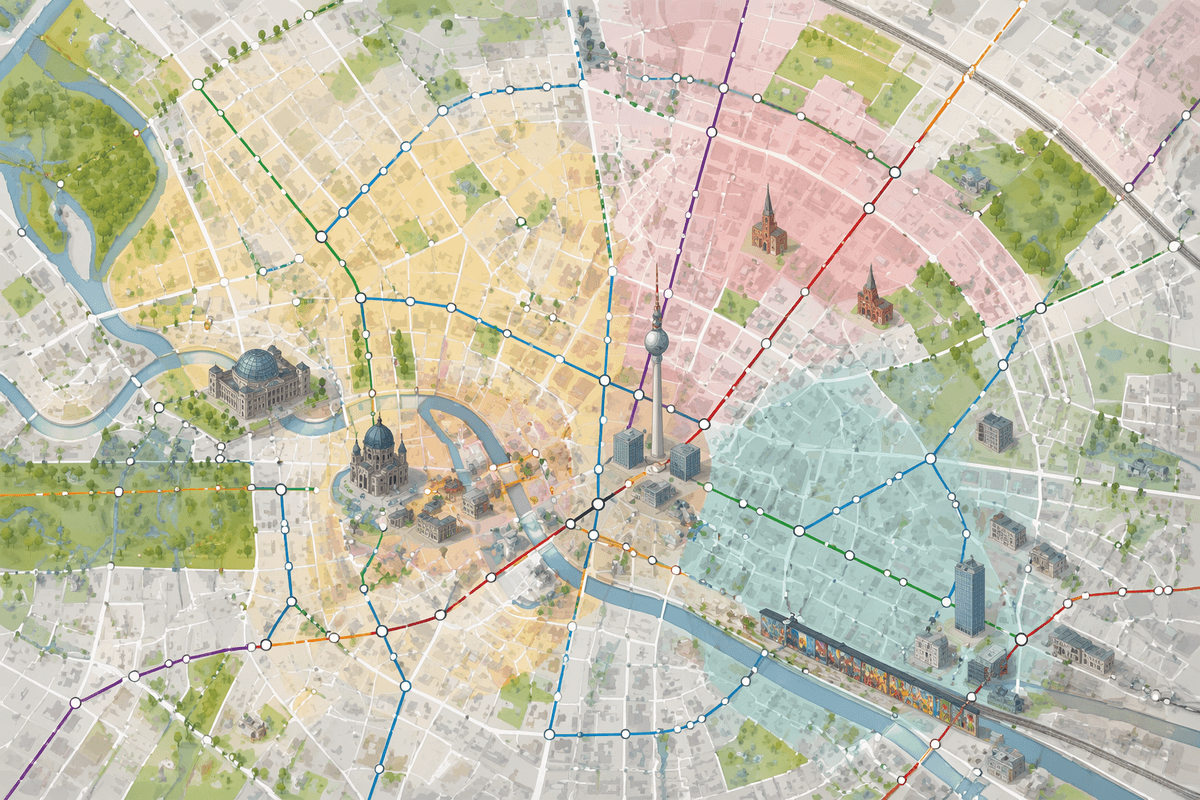
At 9:40 a.m. outside Eberswalder Straße, I hesitated with a coffee in one hand and my phone in the other, watching the M10 tram slide past like it was making fun of my “walking-first” plan. The map suggested I could drift toward Mitte on foot, but the morning air had that Berlin edge, and I could already feel yesterday’s kilometers in my calves. It was the first time I noticed how quickly a long weekend turns into a scheduling problem.
Berlin rewards you when you treat each kiez like a self-contained loop, not a dot on a checklist. Build mornings around one “serious” cluster—Mitte for government/history, Museum Island, or the Topography of Terror area—then switch to a neighborhood that’s better for unplanned stops (Prenzlauer Berg for cafés and parks, Kreuzberg for food and canals, Friedrichshain for river walks and bars). A 30–60 minute cross-city walk is rarely a scenic highlight here; it’s often just efficient-looking on a screen and inefficient in real time.
The timing trick is a reset: return to your base (or at least to a major station) mid-afternoon before your feet start making decisions for you. If you’re solo and flexible, you can improvise dinner inside the kiez you’re already in—great when it’s warm and you’re not chasing reservations. If it’s rainy or you’re on day three, this is when U-/S-Bahn stops being “cheating” and starts protecting your evening.
What I’d do on a first visit
At 8:25 a.m. on day one, I’d be outside Friedrichstraße station with a flaky croissant and the slightly panicked feeling that everything “central” is still a 20-minute walk away. The air would be sharp enough to make me reconsider my jacket choice, and I’d already be timing my first museum slot in my head. That’s the moment I’d decide: walk for texture, ride for distance.
For a first visit, I’d anchor two mornings in Mitte while my legs are fresh: one loop for Brandenburg Gate → Holocaust Memorial → Reichstag area (booked in advance if you care), and one for Museum Island + a slower drift toward Hackescher Markt. I’d walk those clusters because the payoff is density—history per kilometer is high—then use S-/U-Bahn to avoid turning “just one more sight” into a 55-minute gray corridor. This approach works if you like highlights but hate sprinting; it doesn’t work if you insist every transfer is wasted time.
Afternoons and evenings I’d switch kiez and let food steer: Kreuzberg for a canal walk and dinner, Prenzlauer Berg for cafés and low-effort wandering, Friedrichshain only if I’m specifically aiming for the East Side Gallery and staying out late. I’d plan one deliberate long walk (river, park, or neighborhood meander) and treat the rest as optional—because day three feet are real, and Berlin’s spread rewards restraint. If I’m debating a pricier central hotel, my test is simple: will I actually come “home” midday, or just collapse wherever the U-Bahn drops me?