You did the budget, yet money still disappears
By the time the spreadsheet is done, the month already feels “assigned.” Rent is covered, the card payment is scheduled, groceries have a clean number, and there’s even a savings line that looks responsible. Then two weeks in, the checking balance is lower than it should be, and the only answer is a vague pile of transactions that don’t look outrageous. That gap is the part that makes people distrust their own plan: if nothing big happened, why does it feel like the money is evaporating?
In practice, the first thing I look for is timing. If your budget is built monthly but your cash moves weekly—paychecks, autopays, school fees, fuel, meals out—the plan can be “right” and still leave you short on a random Tuesday. The second thing is categories that are technically present but underfunded, so they borrow from everything else without you noticing. Before cutting essentials, assume the budget is missing reality, not discipline.
Your targets were built for a perfect month
The next pattern is the “perfect month” target: the numbers work if nothing unusual happens and the calendar behaves. Groceries are based on an average week, gas assumes normal commuting, dining out assumes a quiet social schedule. Then a long month shows up, a fifth weekend appears, or work runs late three nights in a row and the backup plan is takeout. The targets weren’t careless—they were optimistic—and optimism doesn’t show up as a line item until you’re already behind.
This is why people feel like they’re failing at a budget they technically followed. A target built from last month’s totals quietly ignores the spikes: the higher utility bill in a heat wave, the birthday gifts, the dentist copay, the “one-time” Amazon order that happens every month in a different disguise. When those hit, the budget doesn’t break loudly; it just starts pulling from savings, floating on the credit card, or delaying the next bill. The friction is timing and tolerance: the plan has no room for a not-perfect week.
Adjusting this isn’t about making every category bigger. It’s about choosing which targets must be “minimums” (rent, debt, core groceries) and which need a range. If groceries is $600 in a calm month and $750 in a busy one, pretending it’s always $600 forces a mid-month scramble. A working target is one you can hit in an ordinary month, not an ideal one.
Irregular bills are ambushing your cash flow

By week three, it often isn’t overspending that knocks you off track—it’s a bill that doesn’t arrive on a neat monthly rhythm. Car insurance paid twice a year, annual software renewals, quarterly water, back-to-school fees, HOA dues, license plates, the once-a-year medical deductible hit. Each one is “known,” but when it lands, it lands all at once, and the budget treats it like a surprise.
The cash-flow problem shows up before the bill does. You can be current on everything and still feel squeezed because those future obligations are already spoken for, just not reserved. Then the irregular bill pulls from groceries, then from the credit card float, then from the savings line you were counting on for momentum. The plan didn’t fail; the timing did.
The fix is to turn irregular bills into monthly reservations, even if the bill isn’t due. If the premium is $720 every six months, $120 a month is the real cost of staying insured. The constraint is psychological and practical: it feels like you “lost” $120 of spending room today, and it may force a smaller extra debt payment this month. But it trades a painful ambush later for a controlled decision now.
Your ‘true costs’ aren’t in any category
Once the irregular bills stop blindsiding you, the next squeeze tends to come from expenses that are real, recurring, and still don’t feel like a “bill.” They slip through because they’re not tied to a due date: replacing worn shoes, a laptop battery, haircuts, school photos, professional dues, gifts, small home repairs, pharmacy runs, pet meds, the extra $40 here and there to keep a household functioning. In a clean budget, those end up scattered across “misc,” pushed onto the card, or quietly absorbed by whatever category still has room.
The giveaway is a month where every major line item behaved, but the checking balance still drifted down and the card didn’t get paid as aggressively as planned. These are your true costs: the stuff you’d pay even in a “normal” month if you weren’t postponing it. The constraint is naming them without creating 40 categories. A simple move is one holding bucket—“Household true costs” or “Life admin”—funded with a fixed monthly amount, and a rule that anything non-monthly-but-inevitable gets paid from there first.
At first it can feel like you’re admitting defeat because savings or extra debt payoff shrinks. But after two or three cycles, the plan stops being constantly corrected mid-month, and you can finally tell the difference between a real overspend and a cost you were always going to have.
Leakage spending is small, frequent, and invisible
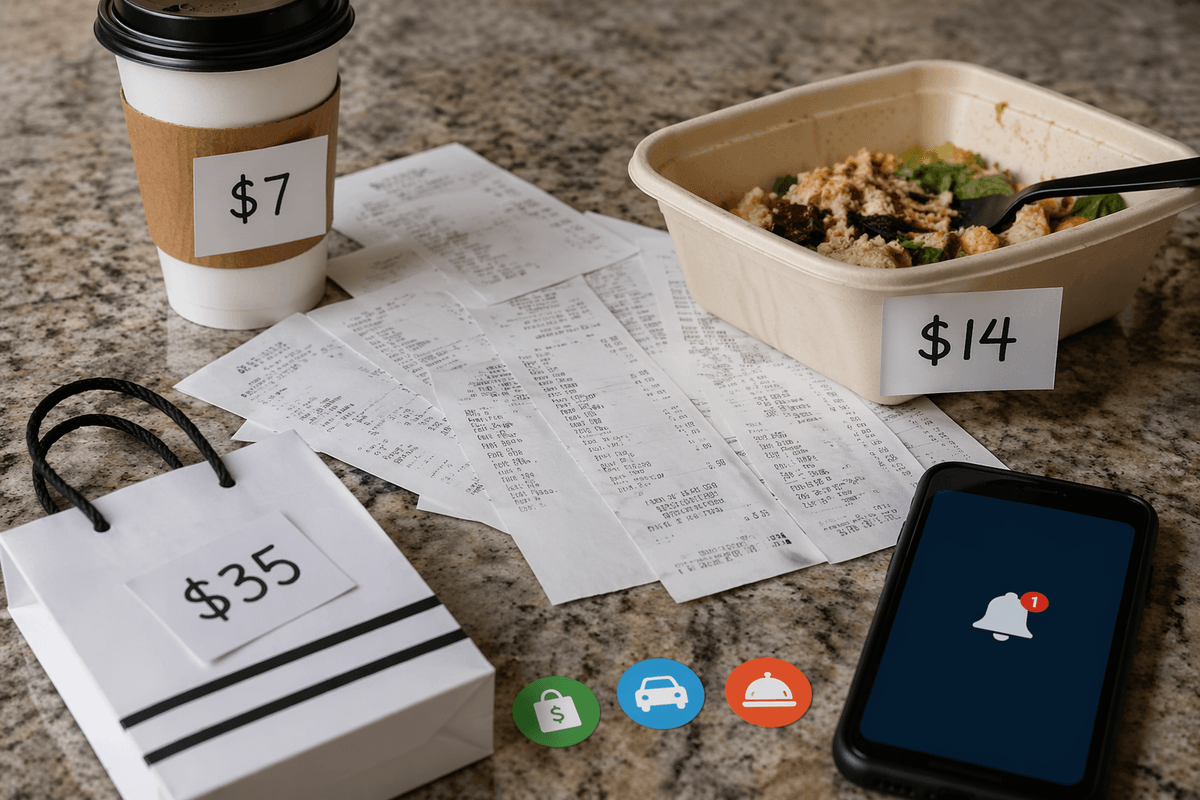
Once you’ve given true costs a place to live, the remaining drift is usually not dramatic—it’s repetitive. A $7 coffee because the morning went sideways, a $14 lunch because the meeting ran long, a “quick” $32 run into Target, the app subscription that renewed during a busy week, the delivery fee that quietly doubles the meal. None of it feels like a budget event, and that’s the problem: leakage doesn’t trigger a decision, it just happens in the gaps between decisions.
The constraint is visibility without turning your life into a bookkeeping project. I’ll often have people add one deliberate category—“leakage/extra convenience”—with a small weekly cap and a rule: any under-$25 impulse, fee, or convenience spend goes there first, no debate. If it runs out on Friday, the weekend adjusts in real time, instead of the month getting “mysteriously” tight on the 23rd.
After a couple of weeks, the pattern usually shows itself. It’s rarely “stop buying coffee.” It’s that the plan assumed calm days, and your real week keeps paying for speed.
Your budget has no flexibility when life changes
The month you finally feel on track is often the month life edits the script. A kid gets sick, the car needs a tow, a work trip shifts the grocery week, or an aging parent needs help with a flight. The budget might still be “balanced,” but it’s balanced like a stack of plates: one nudge and the only way to keep everything upright is to steal from whatever line item is easiest. That’s when people start treating the budget as a scolding document instead of a tool.
What’s missing isn’t another category—it’s a rule for change. A simple flexibility layer is a monthly “pivot fund” (even 2–5% of take-home) that exists to absorb the unplanned without touching rent, minimum debt payments, or the irregular-bills reserves you already built. The constraint is that it feels slow: extra savings or payoff drops in the short term. But it replaces the worst kind of surprise—finding out you were “over budget” only after the card statement closes.
Once the pivot fund is real, mid-month decisions get cleaner. You stop negotiating with groceries every time something happens, and you start asking a better question: is this a one-off that the pivot fund can cover, or is it a new true cost that needs to be built into next month’s targets?
A working budget is a system, not a number
At this point, the budget stops being a document you “finish” and becomes something you run. The people who finally feel the month settle down usually aren’t more strict—they’re more consistent about check-ins. Ten minutes once a week (and a quick look the day after payday) is enough to move money between groceries, leakage, true costs, and the pivot fund while the choices are still small. The constraint is time and attention: if it takes an hour, it won’t happen.
The system part is simple rules. Autopay the fixed bills, reserve monthly for irregulars, keep one true-costs bucket, cap leakage weekly, and only adjust the plan in those scheduled check-ins. When the pivot fund gets used, it triggers a decision: refill it next paycheck, or admit the expense is now recurring and fund it going forward. The number matters, but the cadence is what keeps it honest.




![6 Best Money Market Funds [Protect Your Savings in 2026]](static/image/2026/07/14/fc8225e7-a6f6-459f-8150-f54bd9c52f6f.png)