It’s not “Vienna or not,” it’s when and where
I hovered over a €238 “last room” listing at 00:17, watching the map jump every time I nudged the pin closer to the arena. The same date range in Leopoldstadt looked walkable on-screen, but the fine print quietly added “non-refundable” and a 45-minute check-in window. That’s when it stopped being “Should I stay in Vienna?” and turned into “Which Vienna, and on which nights?”
Eurovision weeks don’t raise prices evenly; they spike along the simplest transit lines and in the districts people recognize first. If you’re targeting €150–250/night, the squeeze usually hits central, low-friction bases (Innere Stadt, near major U-Bahn interchanges) before it hits perfectly safe, slightly less obvious areas. The trade-off is time versus certainty: a cheaper room that’s two transfers away can look fine until you’re tired, it’s raining, and the post-show crowd flow turns “20 minutes” into “45 and standing.”
What sells out first isn’t the whole city—it’s the easy nights: Friday/Saturday, walkable-to-everything pockets, and anything clearly labeled “refundable.” If you’re going short notice, it can work to grab a refundable hold in a transit-clean district (think one direct line to the arena) and keep watching rates elsewhere, but only if you’re willing to read cancellation rules like a contract. If you hate uncertainty, paying a bit more for fewer transfers is often the cheaper decision in hours.
How far your budget stretches by date
At 09:12 the next morning, I refreshed the same search and watched three options slip past €250 like they’d been waiting for my coffee break. One place that was €199 “free cancellation” now had the same bed, same photos, and a new rule: cancel within 14 days and you eat the first night. It wasn’t dramatic—just a quiet tightening that made “I’ll decide later” feel expensive.
For a four-night stay, your budget stretches very differently depending on which nights you’re anchoring. Midweek can still cough up €170–230 in good transit areas if you’re okay with “plain but reliable,” while Friday/Saturday tend to drag the whole average up—sometimes by one full price tier—because everyone wants the same low-friction base after the show. The limitation is that the cheapest-looking deals often sit on awkward gaps: Sunday check-ins, split stays, or rooms that price low until you click through and the “taxes and fees” land.
If you’re booking short notice, I’d treat dates like a risk slider: lock a refundable option for your peak nights first, then experiment with the flexible nights. That works best for people who can stomach a little spreadsheeting; if you hate uncertainty, don’t gamble on last-minute drops that require perfect timing and a willingness to take a longer ride when you’re already tired. A refundable hold at €240 can be less painful than a €185 bargain that becomes two transfers and 50 minutes in a crowd funnel.
Neighborhood swaps that save real money
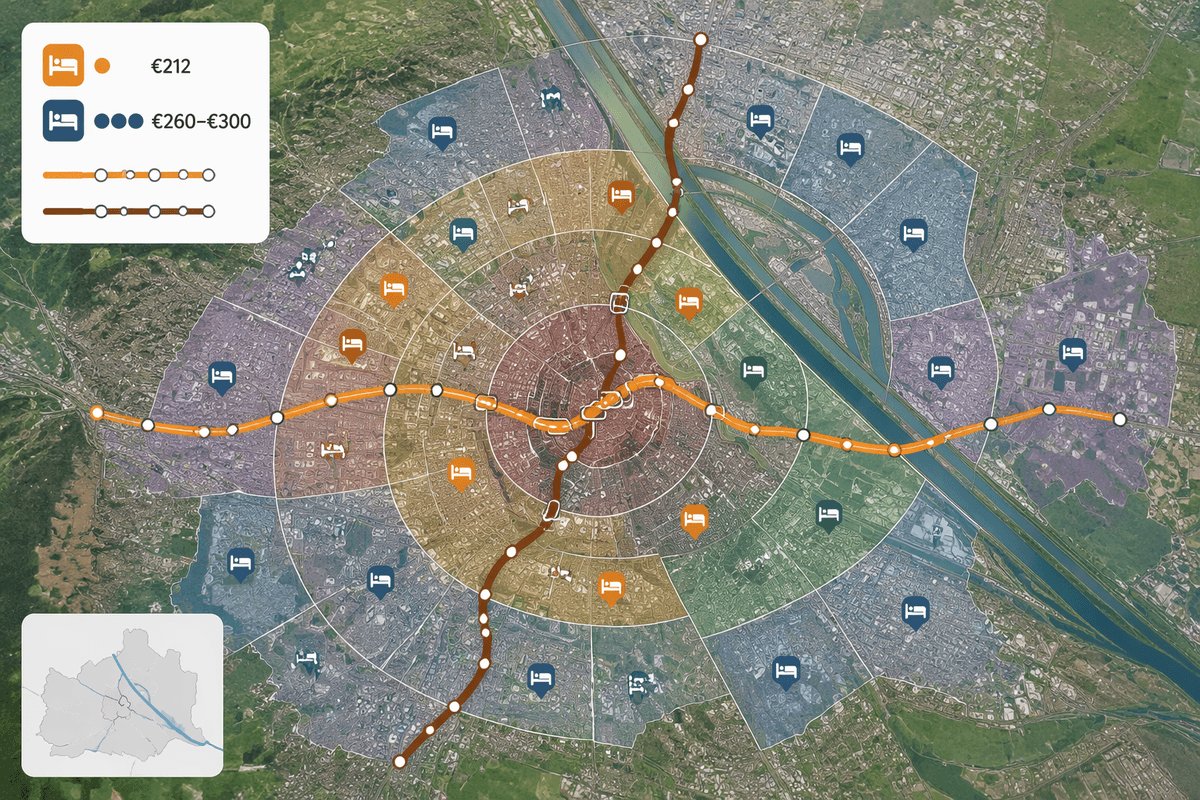
I zoomed the map out until the “central” labels disappeared, then noticed a €212 room sitting just off U3—8 minutes on foot from the station, 2 stops from a major interchange, and somehow still showing free cancellation. On the screen it looked “far,” but in practice it was one clean ride versus the €260–€300 cluster I kept seeing in the postcard districts. That’s the moment the neighborhood choice starts paying you back.
If you’re aiming for €150–250/night, the money usually isn’t in crossing the city—it’s in stepping one ring outward while staying glued to a direct U-Bahn line. Neubau (7) and Mariahilf (6) can undercut the Innere Stadt without feeling disconnected, especially if you’re near U3/U6; Alsergrund (9) and parts of Wieden (4) can price softer while keeping your late-night walk straightforward. The “close to transit” only helps if it’s truly close—an 18-minute walk looks fine at noon, then turns into a slow, wet trudge after the show when crowd flow clogs sidewalks.
For fans who want low stress, I’d rather book “boring but one-line” in Ottakring (16) or Simmering (11) than chase a cheap rate that requires two transfers and perfect timing. It won’t work for people who plan to bounce between bars and fan zones every night; you’ll feel the extra rides. Still, if the listing is within ~5–10 minutes of a U-Bahn entrance and the cancellation rules are sane, that swap is where “short notice” stops automatically meaning “overpay.”
Alternatives when hotels are overpriced

At 23:41, I tried to “filter by apartment” as a reset, and half the pins vanished while the remaining ones came with a €500 deposit line I didn’t notice the first time. A private room popped up at €165, then immediately added a two-night minimum and “arrival only 18:00–20:00.” It wasn’t cheaper so much as differently expensive.
If hotels are blowing past €250/night, I’d look at four substitutes, each with a trade-off. Serviced apartments can work for four nights because you’re buying space and a kitchen, but they’re often stricter on check-in and less forgiving on cancellations than hotels. Hostels (private rooms, not dorms) are usually the best-value “still central” option for mid-budget fans who don’t need quiet-luxury; the limitation is noise and shared bathrooms that feel fine on night one and less fine after a late show.
Outer districts on a single U-Bahn line are the clean compromise when listings say “sold out” in the center—shorter rides than you think, but you pay in late-night crowding and fewer easy food options near your door. The true budget lever is a nearby city (Bratislava is the classic), which suits people who’ll tolerate a fixed train timetable; it doesn’t suit anyone who wants spontaneous post-show hangs. If you’re torn, I’d hold one refundable “good-enough” base now and only gamble with the commute plan if you’re calm about missed connections.
The booking plan I’d use now
I hit “reserve” on a €246 room and the confirmation screen immediately asked me to choose between “pay now, no changes” and “pay later, cancel until 7 days.” The price difference was €18, but the policy difference felt like a cliff. With four nights, that’s the kind of small checkbox that decides whether you’re shopping for value or buying stress.
The plan I’d use now is a two-track hold: first, lock one refundable option in a one-line-to-the-arena district (even if it’s the top of your €150–250 range) and treat it as your safety net. Then set a calendar reminder to re-check rates at specific intervals—10 days out, 7 days out, and 72 hours out—because that’s when inventory shifts without you needing to refresh like it’s a contest vote. This works for people who can tolerate a little admin; it doesn’t work if you’ll forget to cancel in time or you hate reading policy text.
While you’re holding that base, I’d only “gamble” in controlled ways: swap into a better location if the replacement is truly refundable (not “refundable minus first night”), and only jump outward if you’re within an easy walk of a U-Bahn entrance. If everything central keeps climbing, I’d rather accept a slightly boring outer-district room than a nearby-city commute that turns post-show spontaneity into timetable math. At some point, paying €20–€40 more for fewer transfers is just buying back sleep.










![6 Best Money Market Funds [Protect Your Savings in 2026]](static/image/2026/07/14/fc8225e7-a6f6-459f-8150-f54bd9c52f6f.png)