You expect easy savings after turning 50
At 50, the expectation is almost automatic: the price tags should start bending in your favor. A cashier sees the birthday year, a website adds a new checkbox, and everyday costs quietly soften—groceries, flights, hotel nights, maybe even prescriptions. The reality tends to show up differently. You find a “senior” rate that only applies on certain days, at certain locations, after clicking through three screens. Or you ask in person and get a polite no, because the discount starts at 55, 60, or 62 depending on the brand.
That mismatch matters more on a fixed income, because the savings you’re counting on often need to be repeatable, not occasional. The first few offers you test can feel oddly small—5% off here, a free coffee there—while the bigger expenses keep landing at full price. That’s usually when the question shifts from “What do I qualify for?” to “Which discounts behave like real monthly relief?”
First shock: many “senior deals” barely move
The first time you try to “use” being over 50, the numbers often don’t cooperate. A 5% discount sounds like something—until it’s 5% off a $14 lunch, capped at one entrée, not valid with the daily special, and only if the manager rings it up correctly. Even when it works, it lands as a one-time win, not the kind of repeatable savings that changes a monthly budget.
Travel is where the disappointment can feel sharper, because the stakes are higher. A “senior rate” on a hotel site may be a few dollars below the flexible rate, while the nonrefundable or member price is lower anyway. Car rental counters sometimes advertise an age-based program, but the base fare still swings more with timing and location than with the senior label. After a couple of these, the friction becomes the real cost: extra clicks, separate rate codes, and small print for savings that barely move the total.
Membership fees change the math more than discounts

The next temptation is to “solve” the scatter of tiny discounts by joining something—AARP, a warehouse club, a hotel loyalty program with a paid tier, an airline card with an annual fee. The pitch feels clean: pay once, save everywhere. But on a fixed income, the membership cost is a real bill, and it hits before the savings show up. A $20–$60 annual fee can erase a year of 5% discounts unless you’re already spending in the right places, at the right frequency.
What usually surprises people is how often the member price undercuts the senior price. Hotels are the obvious example: the “senior” rate might be a small nudge off the flexible rate, while a member rate (free to join) is lower and stacks with promos. Paid memberships can still work, but only when there’s a predictable, repeat purchase: prescription discounts you actually use, a specific travel brand you book several times a year, or fuel/grocery volume that reliably clears the break-even point. Otherwise the fee becomes the biggest line item in the deal.
Where savings are usually meaningful in practice
The pattern shifts once the discount touches a bill that comes back every month. Prescription pricing (especially generics), vision and hearing services, and routine labs are where a “percentage off” can finally outrun the hassle—because the starting price is high and the purchase is predictable. The constraint is timing: these savings show up only when you’re already buying, not when you’re “trying out” a perk, so the first month often still feels unchanged.
On the travel side, the most meaningful wins usually come from fixed costs you can control: off-airport parking, baggage fees through a co-branded card you already justify, and midweek hotel stays where flexible pricing is soft. Senior rates can help, but only when they’re competing against the same cancellation terms. If the discount forces a higher-priced refundable rate, the “savings” often disappears before checkout.
The best everyday category is transportation that’s run by policy, not by a cashier’s mood—local transit, regional rail, and some ride services in certain cities. It’s boring, but it’s reliable, and reliability is what turns a deal into budget relief.
The fine print that turns “deal” into hassle
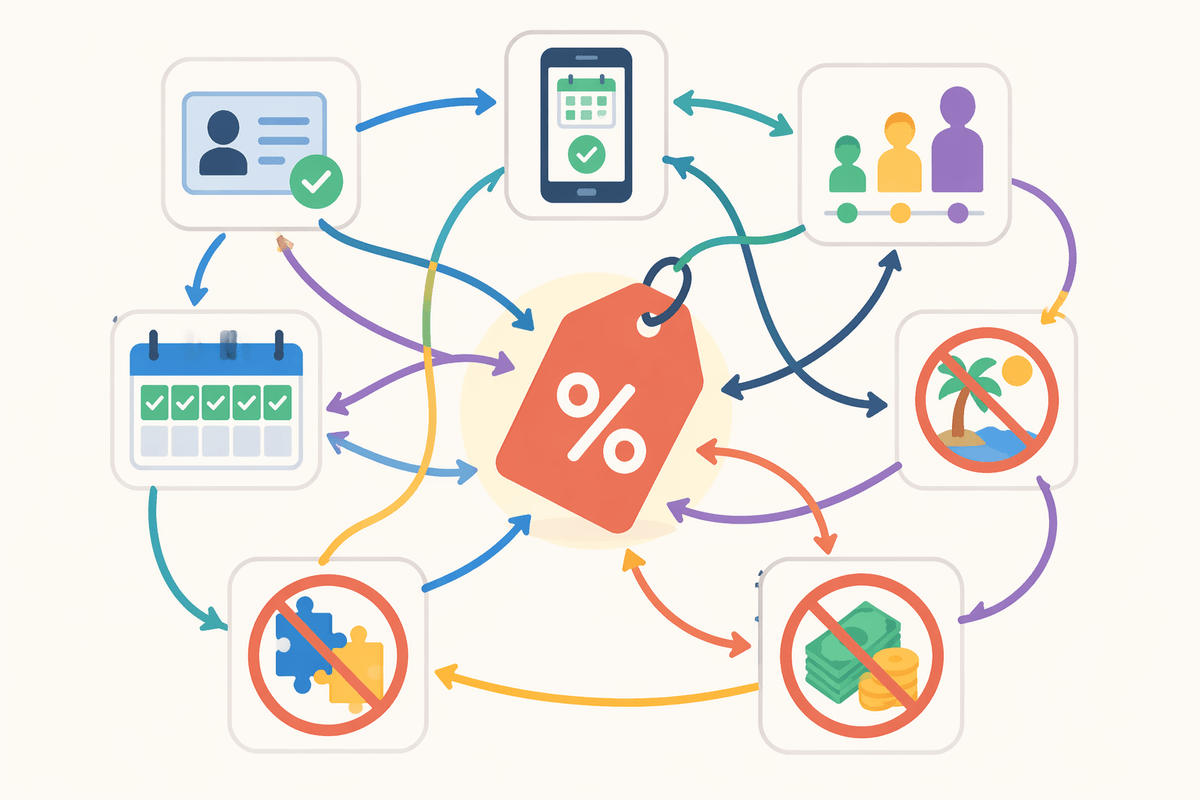
Once you’ve found a discount that could matter, the fine print is usually where the time leak starts. The most common snag is that the “senior rate” is tied to a specific fare class—often the flexible, fully refundable one—so it’s competing against a cheaper member or prepaid price you can actually book. On paper it looks like a break; at checkout it’s a higher total with nicer cancellation terms you didn’t plan to buy.
Eligibility rules create their own friction. Some offers require an ID check at the counter, some require booking through a phone line, and some only apply to a narrow age band (55+, 60+, 62+) even when the marketing says “senior.” Then there are caps and exclusions: one item per table, weekdays only, not valid on holidays, not combinable with coupons, discount applies to base fare but not fees. Each clause is small, but together they turn a repeatable savings plan into a string of one-off exceptions.
Timing and stacking: when savings finally show up
After a few fine-print surprises, the discounts that actually help tend to show up when two things line up: the price is already soft, and the “senior” layer doesn’t force you into a more expensive rate. Hotels are the cleanest example. A midweek stay or a shoulder-season weekend can drop the base rate enough that a small percentage finally matters, but only if the discount applies to the same cancellation terms you’d choose anyway. If the senior rate pushes you back to “flexible,” it’s usually the wrong moment to use it.
Stacking is where the math starts behaving. The reliable stack is: free loyalty member price first, then an age-based rate only if it beats it, then a targeted promo or coupon code, and only then any paid membership benefit you’re trying to justify. The constraint is timing—promos come and go, and some discounts block codes—so it’s worth doing a fast side-by-side before committing. When it works, you don’t “feel” it at checkout; you feel it a month later when the same pattern repeats without extra effort.
Your short list for high-probability savings
By this point the “best” discounts look less like a hunt and more like a small set of defaults that don’t require perfect timing. Keep a free hotel/airline account for member pricing, and only select the senior rate when it beats the member rate on the same cancellation terms. Make local transit and regional rail your “policy-based” win if your area offers reduced fares, because it repeats without negotiation. Put real effort into prescriptions, vision, hearing, and routine labs where comparing cash prices, discount programs, and your plan’s copays can move the needle.
If you pay for a membership, treat it like any other bill: one primary use case, a break-even number, and a calendar reminder to cancel if the year didn’t deliver. Everything else—restaurants, small retail percentages, “exclusive” travel codes—stays optional, not budget-critical.